The 5 Elements in Saju: Wood, Fire, Earth, Metal and Water
The five elements (오행, ohaeng) are the heart of Korean Saju. What each element means, how they feed and balance each other, and how to read the elements in your own chart.
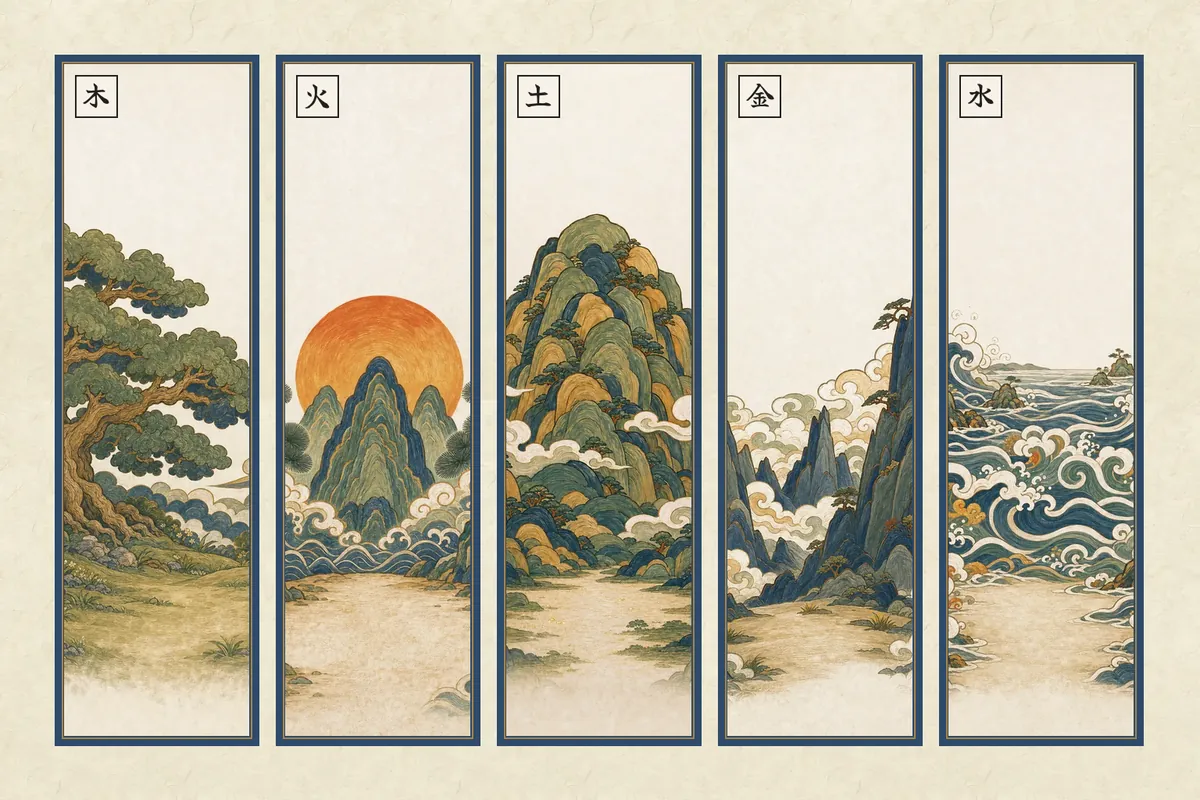
Look closely at a traditional Korean wrapping cloth, the painted eaves of a temple, or a child’s rainbow-striped hanbok sleeve, and you’ll keep seeing the same five colors: blue-green, red, yellow, white and black. They’re called obangsaek (오방색), and they come from the same idea at the center of Saju: the five elements.
If the Day Master is the main character of your chart, the five elements are the language every character speaks.
Quick answer: The five elements (오행, ohaeng) are Wood, Fire, Earth, Metal and Water: five kinds of energy that feed and balance each other in a cycle. Saju reads which elements are strong or quiet in your chart, and which ones your chart welcomes to come into balance.
The five, in one line each
In Korean the five elements are called ohaeng (오행, 五行), literally “five movements.” That word matters. They aren’t five substances so much as five kinds of energy, five ways things move.
| Element | Theme | Picture | Season |
|---|---|---|---|
| Wood | Growth, beginnings, plans | A tree reaching up | Spring |
| Fire | Expression, passion, being seen | A flame spreading out | Summer |
| Earth | Stability, trust, holding the middle | Solid ground | The turns between seasons |
| Metal | Decisions, standards, finishing | A blade, a harvest | Autumn |
| Water | Wisdom, flexibility, rest | A river finding its way | Winter |
Each element has its own article: Wood, Fire, Earth, Metal and Water.
How the elements relate: two cycles
The elements don’t sit still. They act on each other in two ways.
1. The feeding cycle. Each element supports the next:
- Wood feeds Fire (wood burns)
- Fire makes Earth (ash becomes soil)
- Earth holds Metal (ore forms in the ground)
- Metal carries Water (in the traditional image, cool metal gathers dew)
- Water grows Wood (plants drink)
2. The balancing cycle. Each element keeps another in check:
- Wood breaks up Earth (roots push through soil and break it open)
- Earth contains Water (a riverbank)
- Water cools Fire
- Fire shapes Metal (a forge)
- Metal prunes Wood (an axe, a pair of shears)
Think of it like a kitchen. You need heat, water, ingredients, tools and a counter to work on. Too much of one and the meal suffers. Too little of another and you can’t cook at all. Nothing is “bad.” It’s all about the mix.
Reading the elements in a chart
Each of your eight characters belongs to one element. So the simplest first step is to count them.
Here are two fictional examples, both born in 1994:
| Element | Maya (Sept 21, Austin) | Leo (June 12, Seattle) |
|---|---|---|
| Wood | 1 | 2 |
| Fire | 1 | 3 |
| Earth | 2 | 2 |
| Metal | 2 | 1 |
| Water | 2 | 0 |
Maya’s chart has every element, none overwhelming. Leo’s chart leans toward Fire and has no Water.
Traditional Saju rules read these patterns like this:
- When an element is plentiful (as a beginner rule of thumb, three or more visible characters), its strengths come through clearly, along with a matching tendency to overdo it. Plenty of Fire tends to mean warmth and energy, and also a tendency to heat up or rush.
- When an element is scarce, that kind of energy can take more effort or time to access, and simple habits help fill the gap. Little Water often points to not leaving enough time to pause and reflect, so deliberate rest helps.
Counting is only step one
A good reader doesn’t stop at counting, for three reasons:
- Hidden stems. Each animal branch holds hidden elements inside it. An element can be invisible on the surface but tucked inside a branch. That’s why we never call an element “missing” just because the count is zero. (Is an Element “Missing”?)
- The season. The animal of your birth month carries extra weight, and the season shapes how strong each element is. Leo was born in summer, so his Fire is even stronger than “3” suggests.
- Your Day Master. The same element can help one chart and burden another. What matters is how it relates to you.
What your chart “welcomes”
This leads to one of Saju’s most useful ideas: the elements your chart welcomes. These are the energies that bring your chart toward balance.
- If your Day Master is strong, your chart usually welcomes elements that give that strength somewhere to go.
- If your Day Master is weak, it usually welcomes elements that support it.
- If your birth season is extreme (very hot, very cold), your chart may also welcome an element that evens out the climate.
For Leo, a strong Yin Earth Day Master in a hot summer chart, both reasons point the same way: his chart welcomes Water and Metal.
For Maya, a Yang Metal Day Master leaning slightly strong, her chart welcomes Wood and Fire.
Traditionally, people bring welcomed elements into daily life through simple choices: colors, places, activities, even times of day. For Water, that might be time near a lake or river, quiet study, and real rest. These are gentle habits, not magic fixes.
Elements and timing
Every year, month and 10-year cycle brings its own elements too. A year heavy in an element your chart welcomes tends to feel supportive. A year that piles on an element you already have plenty of tends to ask for more pacing. (Luck Cycles and 2027, the Year of the Fire Goat show this in action.)
Common mix-ups
- “Counting tells you everything.” Counting is step one. Hidden stems, your birth season and your Day Master can change the picture.
- “Fire means a bad temper.” Plenty of Fire tends to mean warmth and quick heat. Every element has a gift and a shadow.
- “Wear your lucky color and your luck changes.” Colors and places linked to an element are gentle everyday cues, not charms. They don’t change outcomes on their own.
Questions beginners ask
Which element am I?
Usually people mean the element of their Day Master. But your chart holds all eight characters, so you’re a mix.
Is it bad to have four of one element?
No. It means that element’s strengths are loud, along with its blind spots. What matters is how it fits your Day Master and season.
Can the elements in my chart change?
Your birth chart doesn’t change, but every year, month and 10-year cycle brings its own elements. That’s how Saju talks about timing.
The takeaway
- Five elements, two cycles: feeding and balancing.
- Count them, but also check hidden stems, season and Day Master.
- Balance matters more than having “good” elements.
- Your chart welcomes the elements that bring it toward balance.
Want to see your own element count? Our free calculator shows your Day Master and chart. For the full picture, including hidden stems, the elements your chart welcomes, and simple ways to bring them into your days, see the Korean Saju Birth Chart Reading.
What's your real animal?
Free, about 30 seconds, and your birthday never leaves your phone.
Find my real animal