
Saju vs MBTI: Why Koreans Use Both (and How They Differ)
In Korea, people swap MBTI types and Saju charts the way Americans swap star signs. How the two systems differ, why they don't map onto each other, and how to use both without boxing yourself in.
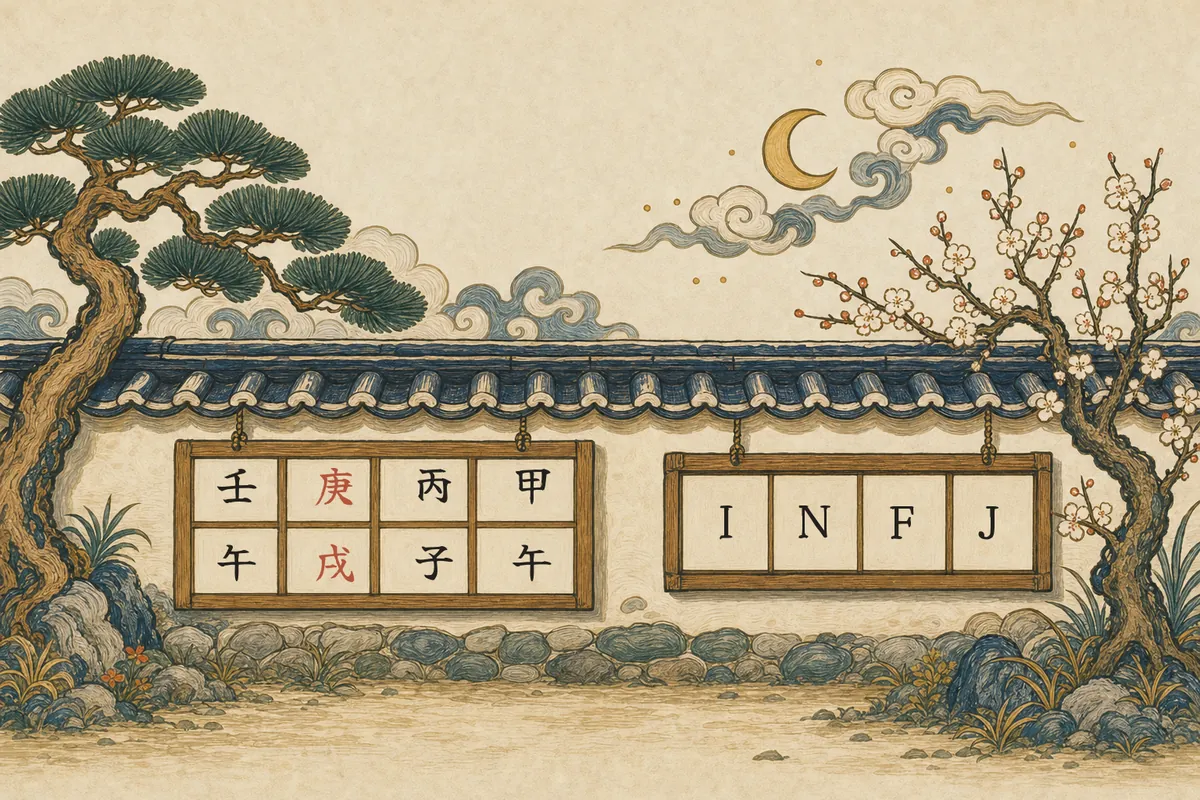
In Korea, “What’s your MBTI?” has become an everyday icebreaker, the kind of question you might hear on a first date or at a new job. And in the same conversation, someone might ask what your Day Master is.
To an American, that combination can sound odd: one is a personality questionnaire, the other an ancient calendar system. But Koreans who use both aren’t confused. They’re using two different tools for two different questions.
Quick answer: MBTI sorts you into one of 16 types based on how you answer a questionnaire, so it describes how you see yourself right now. Saju calculates a chart from your birth date and time, so it never changes, and it adds timing: 10-year cycles and yearly energies. They don’t map onto each other one to one. Many people use MBTI to describe themselves and Saju to think about balance and seasons of life.
The basic difference
| MBTI | Saju | |
|---|---|---|
| Comes from | Your answers to a questionnaire | Your birth date and time (and place, for the exact local time) |
| Number of types | 16 | 10 Day Masters, 60 day pillars, and hundreds of thousands of full charts |
| Can it change? | Your result can shift between tests | Your birth chart never changes |
| Talks about timing? | No | Yes: 10-year cycles, years, months |
| Main question | “How do I tend to think and decide?” | “What’s my nature, what balances it, and what season am I in?” |
Why MBTI took off in Korea
MBTI gives people a quick, shared shorthand. Saying “I’m an introvert-planner type” is an easy, friendly way to explain yourself to someone new. It fits naturally into a culture that already enjoyed saju, blood-type personality talk and zodiac animals as conversation starters.
Saju does something MBTI doesn’t: it talks about time. That’s why people who love MBTI still check their saju at the new year, before a job change, or before a wedding.
Can you match MBTI types to Day Masters?
People try. The internet is full of charts saying “Yang Fire is an ENFP” or “Yin Metal is an ISTJ.” It’s fun, but it doesn’t really hold up:
- A Day Master is one character out of eight. Your season, element balance and the rest of your chart can pull it in very different directions.
- MBTI measures preferences you report, which can shift with mood, job and life stage.
A Yang Metal Day Master can be an introvert or an extrovert. A Yin Water Day Master can love spreadsheets. The systems simply measure different things.
Two lenses on the same person
Take our fictional example Maya (September 21, 1994, Austin). Her Saju chart has a Yang Metal Day Master (decisive, loyal, clear lines), born in autumn, with all five elements present and a slight lean toward strength. Her chart welcomes Wood and Fire: projects to shape and places where her work is seen.
Whatever MBTI type Maya tests as, Saju adds two things a questionnaire can’t:
- What balances her: concrete kinds of activities and environments her chart welcomes.
- What season she’s in: a 10-year cycle since about 2019 that’s about standing on her own and earning trust in a role, with a new cycle starting about 2029.
MBTI might tell her how she likes to make decisions. Saju might tell her what this decade is asking of her.
Using both well
- Use MBTI for quick self-description and communication: how you like to work, recharge and decide.
- Use Saju for balance and timing: what tends to energize your chart, and what kind of season you’re in.
- Use neither as a box. Both are languages for reflection, not verdicts about who you’re allowed to be.
What each one is good at noticing
MBTI is good at how you process things: where you get energy, how you take in information, how you decide, how you like to plan. It’s quick, and it gives two people a shared vocabulary in seconds.
Saju is good at balance and change over time. It can say that a chart runs hot and does well with cooling habits, or that someone is in a decade of building rather than harvesting. It also looks at how two charts meet, which is why Korean couples sometimes compare saju (gunghap) even after comparing MBTI types. (Korean Saju Compatibility)
A simple way to hold both: MBTI is a snapshot of how you see yourself. Saju is a map of the terrain you were born into, with a calendar attached.
Common mix-ups
- “Saju is just MBTI with animals.” Saju is calendar-based and includes timing; MBTI is a questionnaire.
- “My Day Master should match my MBTI.” They measure different things, so mismatches are normal.
- “You have to pick one.” MBTI is a modern personality tool; Saju is a traditional framework for nature and timing. You don’t have to treat either as the final truth about you.
Questions beginners ask
Which is more accurate?
They answer different questions, so “accurate” means different things. MBTI reflects your current self-reports; Saju is a traditional framework for reading a birth moment.
Does my Saju change if my MBTI changes?
No. Your birth chart stays the same; what changes over time is the timing (your cycles and years).
What’s the Saju equivalent of my MBTI type?
The closest everyday equivalent is your day pillar, your Saju Type, of which there are 60. (What Is a Day Pillar?)
Find your Saju “type”
You already know your MBTI. Now find your Saju Type free and see which parts sound like you. For the full picture, including what balances your chart and the season you’re in now, see the Korean Saju Birth Chart Reading.
What's your real animal?
Free, about 30 seconds, and your birthday never leaves your phone.
Find my real animal