What Are the Four Pillars: Year, Month, Day and Hour?
Saju means four pillars: your birth year, month, day and hour. How each pillar is found, what each one represents, and why your birth time may land in a different hour than you think.
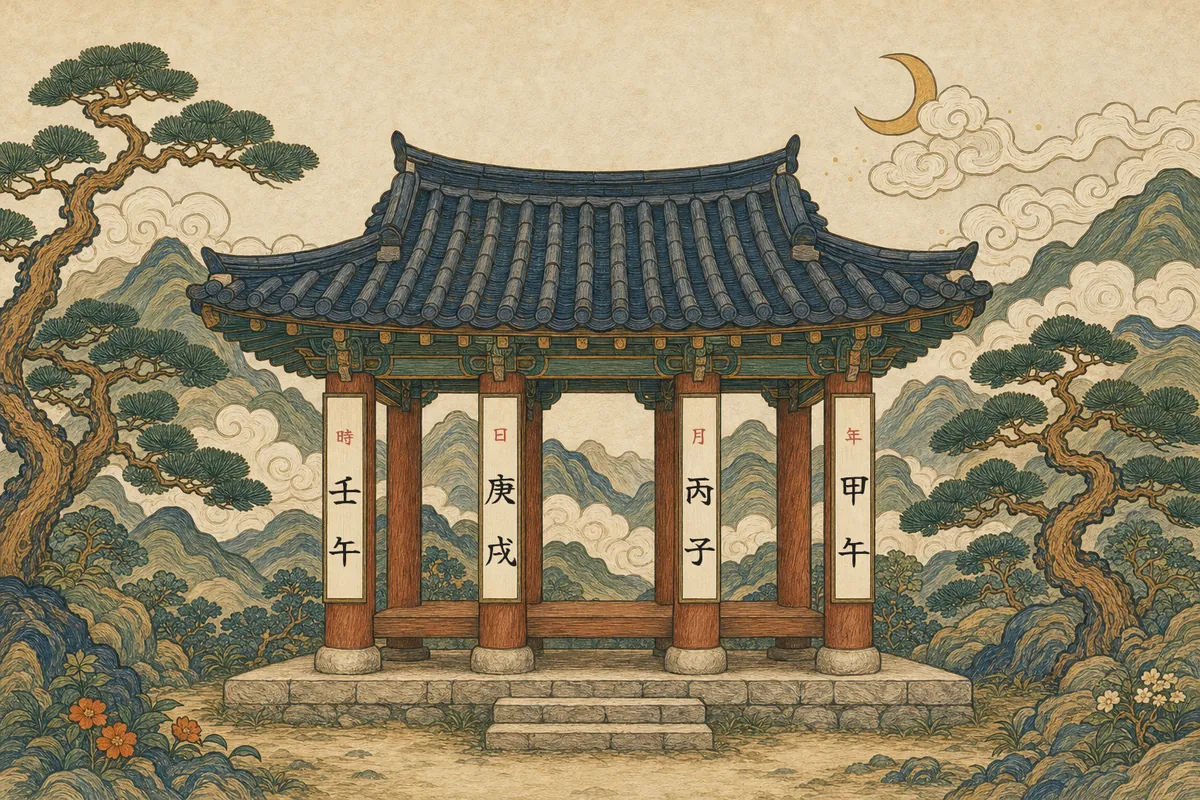
Imagine a clock with four hands instead of two. One hand moves once a year. One moves once a month. One ticks forward every day, and one every two hours. Stop that clock at the moment you were born, write down where all four hands point, and you have your Saju chart.
That’s really what the “four pillars” are: four readings of time, taken at once.
Quick answer: Saju’s four pillars are your birth year, month, day and hour, each written as two characters: a Heavenly Stem on top and an animal (Earthly Branch) below. Roughly, the year is your roots, the month your season and setting, the day is you, and the hour your plans and later life.
Each pillar has two layers
Every pillar holds two characters:
- On top, a Heavenly Stem. There are ten. Each is an element (Wood, Fire, Earth, Metal or Water) in either a yang (outgoing) or yin (inward) form.
- On the bottom, an Earthly Branch. There are twelve, each paired with an animal and an element.
The stem is like the weather above a field. The branch is the soil underneath. You need both to know what grows there. (Heavenly Stems and Earthly Branches, Explained Simply covers all 22.)
The year pillar: your roots
How it’s found: by the Saju year you were born in. That year begins at the Start of Spring (입춘, Ipchun), around February 4, not January 1.
What it points to: your roots, family background, early life, and the wider society around you. It’s the outer edge of the chart, where you first meet the world.
The bottom half of this pillar is your famous zodiac animal. (Your Zodiac Sign Is Only 1 of Your 8 Characters explains why that’s just the start.)
The month pillar: the season you were born into
How it’s found: by the solar terms, points on the sun’s yearly path. The Saju month doesn’t start on the 1st. It starts when the sun crosses one of these points, usually between the 4th and the 8th of a calendar month.
Each month always has the same animal:
| Saju month begins around | Animal |
|---|---|
| Feb 4 | Tiger |
| Mar 6 | Rabbit |
| Apr 5 | Dragon |
| May 6 | Snake |
| Jun 6 | Horse |
| Jul 7 | Goat |
| Aug 8 | Monkey |
| Sep 8 | Rooster |
| Oct 8 | Dog |
| Nov 7 | Pig |
| Dec 7 | Rat |
| Jan 6 | Ox |
(Exact dates shift by a day or so each year.)
What it points to: the setting you grew up in, your family ties, and the base of your work and social life. It also tells you your birth season, which matters a lot. A Metal person born in autumn (Metal’s season) feels very different from a Metal person born in summer.
The day pillar: you
How it’s found: by a cycle of 60 days that has been counted without a break for centuries. It doesn’t reset at the start of a month or a year. It just keeps rolling, like a very old odometer.
What it points to: you yourself, and the place of your closest partner. The top character here is your Day Master, the most important character in your chart. (What Is a Day Pillar? goes deeper.)
The hour pillar: your plans and what comes later
How it’s found: by your birth time, in two-hour blocks:
| Time | Animal | Time | Animal |
|---|---|---|---|
| 11 p.m.–1 a.m. | Rat | 11 a.m.–1 p.m. | Horse |
| 1–3 a.m. | Ox | 1–3 p.m. | Goat |
| 3–5 a.m. | Tiger | 3–5 p.m. | Monkey |
| 5–7 a.m. | Rabbit | 5–7 p.m. | Rooster |
| 7–9 a.m. | Dragon | 7–9 p.m. | Dog |
| 9–11 a.m. | Snake | 9–11 p.m. | Pig |
What it points to: your plans, the people you guide or care for, and later life.
The clock-time trap (and solar time)
Here’s something worth checking in any calculator. The two-hour blocks follow the sun, not the clock on your wall. Time zones are wide, and daylight saving time moves clocks by an hour. So “2 p.m.” on your birth certificate might be closer to 1 p.m. by the sun, or even earlier.
Many careful Saju calculators, including ours at Pathlight, adjust your birth time to local solar time: where the sun actually was at your birthplace, based on its longitude. (Some calculators use clock time instead, which is one reason results can differ.)
Take Maya, our fictional example, born September 21, 1994, at 2:20 p.m. in Austin, Texas. On the clock, that looks like the Goat hour (1–3 p.m.). But Austin was on daylight saving time, and it sits far west in its time zone. Adjusted to the sun, her birth was closer to 12:49 p.m., which is the Horse hour. Her hour pillar is 壬午, Water Horse, not a Goat pillar at all.
Same birth certificate, different hour pillar. That’s why your birth city matters.
Putting the pillars together
Here’s Maya’s full chart. Korean Saju charts, and our readings, traditionally list the pillars from right to left in time: the year sits on the far right and the hour on the far left.
| Hour | Day | Month | Year | |
|---|---|---|---|---|
| Stem | 壬 Yang Water | 庚 Yang Metal | 癸 Yin Water | 甲 Yang Wood |
| Branch | 午 Horse | 戌 Dog | 酉 Rooster | 戌 Dog |
Read from right to left, it’s a little life story: Wood Dog roots, a Water Rooster autumn season, a Metal Dog self, and a Water Horse future. A reader would start from her Day Master (庚, Yang Metal), then look at how every other character supports, challenges or balances it.
A helpful way to remember
- Year = where you come from
- Month = the season and setting you grew up in
- Day = who you are
- Hour = where you’re heading
No pillar is good or bad on its own. What matters is how they work together.
Questions beginners ask
Does the Saju month start on the 1st?
No. It starts at a solar term, usually between the 4th and the 8th of the calendar month.
Which pillar matters most?
The day pillar, because its top character is your Day Master. The month pillar comes next, because it sets your birth season.
Does daylight saving time matter?
Yes. Saju hours follow the sun, so a careful chart removes daylight saving time and adjusts for your birthplace’s longitude before choosing your hour pillar.
Do twins have the same chart?
If they were born in the same two-hour block, usually yes: the same eight characters. A chart describes tendencies; two people with the same chart still grow up, choose and live differently.
What if you only know three?
Many people don’t know their birth time. That’s fine. You’ll have three pillars (six characters), and a good reading will say clearly which parts it can’t speak to. See What If You Don’t Know Your Birth Time?.
If you want to see your own four pillars, you can find your Day Master free. And if you’d like the whole chart read for you, pillar by pillar and with your birth time adjusted to your birthplace, the Korean Saju Birth Chart Reading does exactly that.
What's your real animal?
Free, about 30 seconds, and your birthday never leaves your phone.
Find my real animal