Heavenly Stems and Earthly Branches, Explained Simply
Every Saju chart is built from 10 Heavenly Stems and 12 Earthly Branches. Here's what each one means, with simple pictures for all 22 characters.
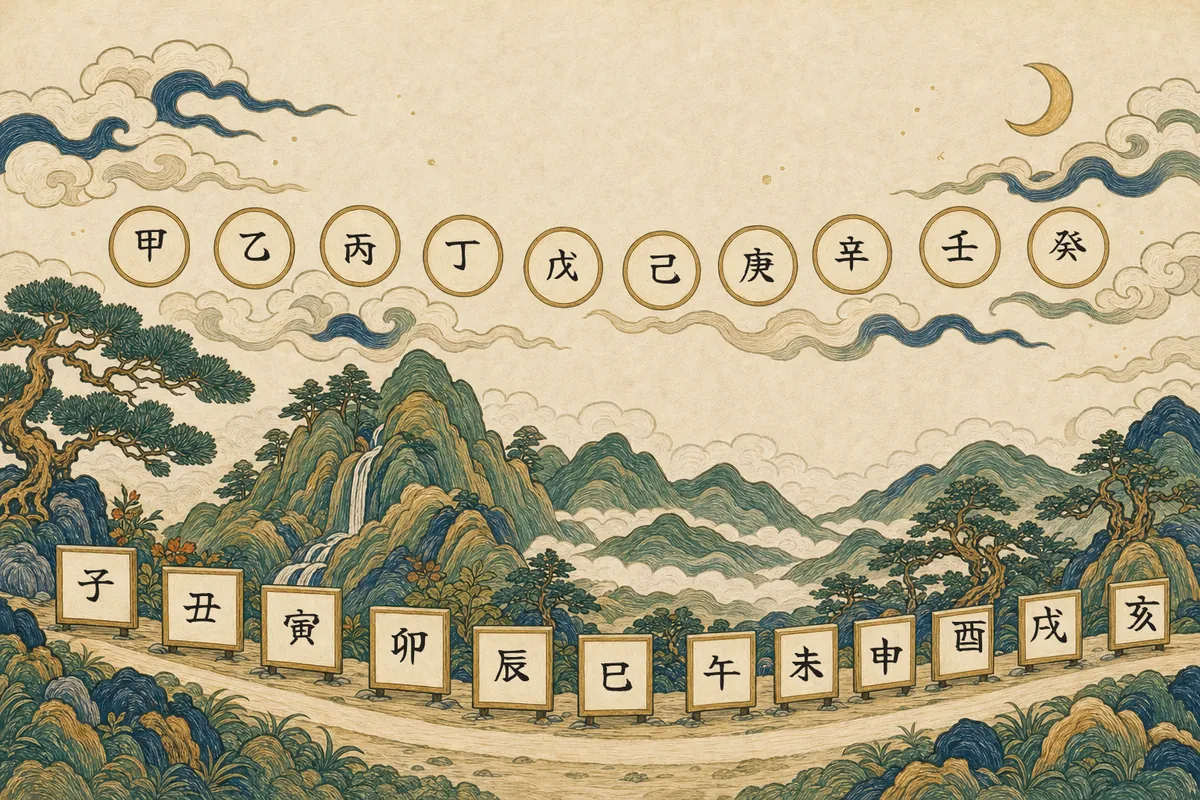
Every Saju chart, no matter whose it is, is written with the same 22 characters. Ten of them sit on top of the pillars. Twelve sit underneath. Learn those 22, and you can read the outline of any chart, the way knowing 26 letters lets you sound out any English word.
That sounds like a lot. It isn’t, once you see the pictures behind them.
Quick answer: Heavenly Stems are the 10 characters on top of each pillar: the five elements, each in a yang and a yin form. Earthly Branches are the 12 animals underneath, each tied to an element, a month and a two-hour block, and each holding hidden stems inside.
Two kinds of characters
- Heavenly Stems (천간, cheongan): 10 characters that sit on top of each pillar.
- Earthly Branches (지지, jiji): 12 characters that sit on the bottom. These are the zodiac animals.
A simple way to picture it: the stem is what shows on the surface, like the weather over a field. The branch is the ground below, with things buried in it. A stem is one clear energy. A branch is more layered, because it holds hidden stems inside it.
The 10 Heavenly Stems
The stems are the five elements, each in two forms. Yang is the outgoing, big, visible version. Yin is the inward, fine, flexible version. Think of a tree versus a vine: both are Wood, but they grow very differently.
| Stem | Korean | Name | Picture | Traditional sense |
|---|---|---|---|---|
| 甲 | Gap | Yang Wood | A tall, straight tree | Drive, principle, growing in one direction |
| 乙 | Eul | Yin Wood | Grass and vines | Flexibility, persistence, connecting people |
| 丙 | Byeong | Yang Fire | The sun | Brightness, expression, lighting up a room |
| 丁 | Jeong | Yin Fire | A candle or lamp | Focus, warmth, a quiet inner flame |
| 戊 | Mu | Yang Earth | A mountain or a dam | Steadiness, responsibility, holding the center |
| 己 | Gi | Yin Earth | Field soil | Practical care, attention to detail, growing things |
| 庚 | Gyeong | Yang Metal | Raw ore, a strong blade | Decisiveness, loyalty, clear lines |
| 辛 | Sin | Yin Metal | A polished jewel | Precision, high standards, a fine eye |
| 壬 | Im | Yang Water | A great river or the sea | Wide view, wisdom, moving with the current |
| 癸 | Gye | Yin Water | Rain and dew | Intuition, sensitivity, quiet depth |
When one of these is your Day Master (the top of your day pillar), it becomes the character that stands for you. (The 10 Day Masters has a section for each.)
The 12 Earthly Branches
The branches are the twelve animals. Each also has an element, a month of the year, and a two-hour block of the day.
Beginner note: you don’t need to memorize these. The goal is to see the pattern.
| Branch | Animal | Element | Saju month starts around | Hours |
|---|---|---|---|---|
| 子 | Rat | Water | Dec 7 | 11 p.m.–1 a.m. |
| 丑 | Ox | Earth | Jan 6 | 1–3 a.m. |
| 寅 | Tiger | Wood | Feb 4 | 3–5 a.m. |
| 卯 | Rabbit | Wood | Mar 6 | 5–7 a.m. |
| 辰 | Dragon | Earth | Apr 5 | 7–9 a.m. |
| 巳 | Snake | Fire | May 6 | 9–11 a.m. |
| 午 | Horse | Fire | Jun 6 | 11 a.m.–1 p.m. |
| 未 | Goat | Earth | Jul 7 | 1–3 p.m. |
| 申 | Monkey | Metal | Aug 8 | 3–5 p.m. |
| 酉 | Rooster | Metal | Sep 8 | 5–7 p.m. |
| 戌 | Dog | Earth | Oct 8 | 7–9 p.m. |
| 亥 | Pig | Water | Nov 7 | 9–11 p.m. |
Notice a pattern? The animals follow the seasons. Tiger and Rabbit (Wood) are spring. Snake and Horse (Fire) are summer. Monkey and Rooster (Metal) are autumn. Pig and Rat (Water) are winter. And the four Earth animals, Ox, Dragon, Goat and Dog, sit at the turns between seasons, like hinges on a door.
(The 12 Animals in Korean Saju looks at each animal more closely.)
Hidden stems: what’s inside a branch
Here’s where branches get interesting. Each branch carries two or three hidden stems (지장간, jijanggan). They’re like the layers in the soil: you don’t see them on the surface, but they shape what grows.
A few examples, grouped by element for simplicity:
- Rabbit (卯) holds Yang Wood and Yin Wood, so for beginner element reading it counts as pure Wood.
- Dog (戌) holds Yin Metal, Yin Fire and Yang Earth. A dry autumn field with a little spark inside.
- Snake (巳) holds Yang Earth, Yang Metal and Yang Fire.
Hidden stems are why Saju readers never say an element is “missing” just because it doesn’t show on the surface. It may be tucked inside a branch. (Is an Element “Missing” From Your Chart? explains this rule.)
Seeing it in a real chart
Here’s Leo, a fictional example born June 12, 1994, at 6:30 a.m. in Seattle:
| Hour | Day | Month | Year | |
|---|---|---|---|---|
| Stem | 丁 Yin Fire | 己 Yin Earth | 庚 Yang Metal | 甲 Yang Wood |
| Branch | 卯 Rabbit | 巳 Snake | 午 Horse | 戌 Dog |
Reading it with what you now know:
- His Day Master is 己, Yin Earth: field soil.
- He was born in the Horse month, midsummer, Fire season.
- His branches include two Fire animals (Snake and Horse), and there’s a Yin Fire stem too. That’s three Fire characters on the surface, in a chart born in summer. Fire feeds Earth, so his soil is very warm.
- There’s no Water anywhere, not even hidden inside a branch. A reader would say this chart welcomes Water (and Metal) for balance.
That’s already a real reading, built from nothing more than the 22 characters above.
Questions beginners ask
Do I need to learn the Chinese characters?
No. Every character has an English name, and good readings always give it. The characters are just a compact way to write a chart.
Why does one animal hold more than one element?
Because of hidden stems. A branch is like layered soil: one main element, sometimes with one or two quieter ones underneath.
Does yang mean masculine and yin feminine?
Not in a chart. Yang is the outgoing, visible form and yin the inward, refined form. Anyone can have either as a Day Master.
The short version
- 10 stems on top: five elements, each yang or yin.
- 12 branches below: twelve animals, each with an element, a month and an hour.
- Branches hold hidden stems, so they’re more layered than stems.
- Stems and branches pair up into 60 combinations. (Korean Saju Has 60 Types)
You can find your own eight characters free and match them against these tables. And if you’d like your chart read for you, hidden stems and all, the Korean Saju Birth Chart Reading explains every character in plain English.
What's your real animal?
Free, about 30 seconds, and your birthday never leaves your phone.
Find my real animal