Ten Gods, Simply: How Saju Reads Work, Money, Love and Friends
The Ten Gods (십성, sipseong) are how Korean Saju talks about work, money, love and friends. A plain-English guide to the five groups and ten roles, with a real-looking chart example.
Here’s a question people ask about Saju all the time: “If it’s all just elements, how does it say anything about my job, my money or my love life?”
The answer is the Ten Gods. Don’t let the name throw you. There are no gods involved. It’s a system of roles: every character in your chart gets a job title based on how it relates to you.
Quick answer: The Ten Gods (십성) are roles. Every character in your chart gets one based on how its element relates to your Day Master: peers, output, wealth, structure or support, each in two forms. They’re how Saju talks about work, money, love and friends.
The big idea: everything is relative to you
Your Day Master (the top character of your day pillar) represents you. Every other character in your chart has an element, and that element relates to yours in one of five ways:
- Same element as you → your peers, your sense of self
- The element you feed → what you put out: talent, expression, results
- The element you control → what you manage: money, opportunities, practical life
- The element that controls you → structure: rules, responsibility, reputation
- The element that feeds you → support: learning, help, inner steadiness
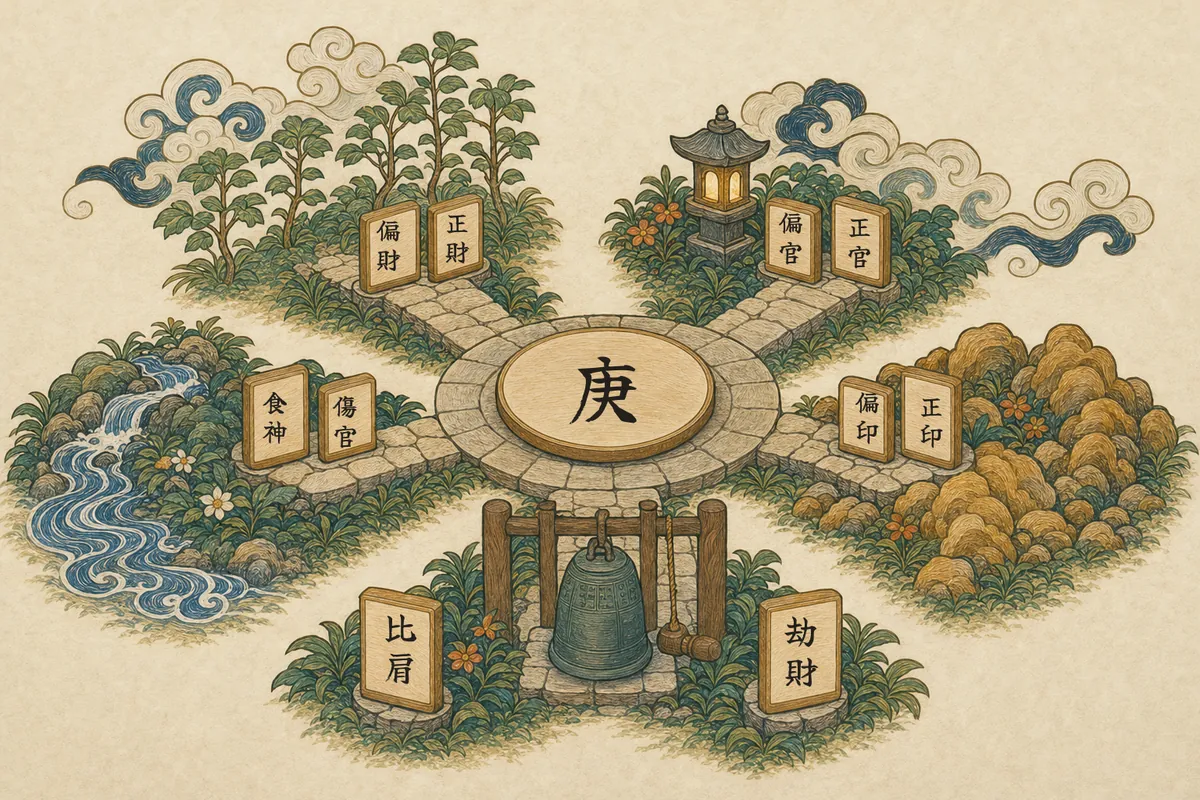
That’s the whole system in five lines. Each of those five relationships splits into two (one where the yin/yang matches yours, one where it doesn’t), which gives you ten roles. In Korean they’re called sipseong (십성, 十星), the “ten stars.”
Think of it like a workplace. Your Day Master is you. Everyone else in the building has a role relative to you: coworkers, the projects you produce, the budget you manage, the boss, the mentor.
The five groups and ten roles
We use plain-English names in our readings. The traditional names are in parentheses.
| Group | Role | What it traditionally points to |
|---|---|---|
| Self & Peers | Peer Energy (Friend · 比肩) | Independence, standing shoulder to shoulder with peers |
| Competing Peers (Rob Wealth · 劫財) | Drive, competitiveness, rallying people | |
| Expression & Output | Creative Output (Eating God · 食神) | Steady productivity, enjoying life, building expertise |
| Expression & Change (Hurting Officer · 傷官) | Bold ideas, words, wanting to change the rules | |
| Wealth & Opportunity | Opportunity Wealth (Indirect Wealth · 偏財) | Resources in circulation, business sense, a wide range of activity |
| Steady Wealth (Direct Wealth · 正財) | Saving, planning, a stable base | |
| Structure & Recognition | Pressure & Leadership (Seven Killings · 七殺/偏官) | Responsibility under pressure, crisis skills, leadership |
| Recognition & Responsibility (Direct Officer · 正官) | Order, trust, being recognized within a structure | |
| Support & Learning | Intuitive Insight (Indirect Resource · 偏印) | Unusual learning, intuition, deep specialist focus |
| Study & Support (Direct Resource · 正印) | Learning, documents, people who help you, peace of mind |
Some traditional names sound alarming (“Rob Wealth,” “Hurting Officer,” “Seven Killings”). They’re old labels, and they’re not warnings. Every role has a strength and a shadow, which is why we use the plainer names.
How this maps to real life
- Work: look at Expression & Output (what you produce) and Structure & Recognition (your role, title and responsibility).
- Money: look at Wealth & Opportunity, and at whether your chart has the strength to handle it.
- Friends and colleagues: look at Self & Peers.
- Learning and support: look at Support & Learning.
- Love: traditional Saju also names a “relationship star” from these groups, which differs depending on the chart owner’s gender. It’s read alongside the day branch, the seat of your closest partner. (What Your Element Says About Love)
An example: Maya’s roles
Our fictional example Maya (September 21, 1994, Austin) has a Yang Metal (庚) Day Master. Here’s how her other seven characters line up:
| Character | Element | Role in her chart |
|---|---|---|
| 甲 (year stem) | Yang Wood | Opportunity Wealth |
| 戌 (year branch) | Earth | Intuitive Insight |
| 癸 (month stem) | Yin Water | Expression & Change |
| 酉 (month branch) | Metal | Competing Peers |
| 戌 (day branch) | Earth | Intuitive Insight |
| 壬 (hour stem) | Yang Water | Creative Output |
| 午 (hour branch) | Fire | Recognition & Responsibility |
Count by group: Expression & Output 2, Support & Learning 2, and 1 each of Self & Peers, Wealth & Opportunity, and Structure & Recognition. Every group appears at least once.
What might a reader say? Something like: Maya has two kinds of output, steady work and bold ideas, and two Dogs giving her an unusual, intuitive way of learning. Her one Wealth character sits far out in her year pillar, and her one Structure character sits in her hour pillar, the pillar of plans and what’s ahead. That’s a far more specific picture than “Metal people are decisive.”
The Ten Gods change with time
The same roles apply to each year and 10-year cycle. Every year’s characters also take on a role relative to your Day Master.
For Maya, 2027 (丁未, Fire Goat) brings Recognition & Responsibility (from the Yin Fire stem) and Study & Support (from the Goat). In plain terms: a year where a more visible role and real learning are both in the air. For our other fictional example, Leo (a Yin Earth Day Master), the same year brings Intuitive Insight and Peer Energy instead. Same year, different roles, because the roles depend on who’s receiving them. (2027, the Year of the Fire Goat)
Common mix-ups
- “I have no Wealth stars, so I’ll never have money.” No. A missing group means that theme isn’t loud in your birth chart. It can show up through hidden stems and through timing, and money in real life depends on far more than a chart.
- “Seven Killings is bad.” It’s the old name for Pressure & Leadership. It often shows up in people who perform well under pressure.
- “More Wealth stars = richer.” Not necessarily. A Day Master that’s weak may find a lot of Wealth more burden than gift. Balance matters.
Questions beginners ask
Why are they called gods?
The English name comes from the Chinese term 十神, meaning “ten gods” or “ten spirits.” In Korean the same roles are usually called sipseong (십성, 十星), the “ten stars.” Either way, there’s nothing religious about them; they’re labels for relationships.
Should beginners learn the Ten Gods?
After your Day Master and the five elements. They make much more sense once you know your own element.
Which role is money and which is love?
Money is mainly the Wealth & Opportunity group. Love is read from the day branch plus a traditional relationship star, and from how your elements meet another person’s.
The short version
- The Ten Gods are roles, based on how each character relates to your Day Master.
- Five groups: Self & Peers, Expression & Output, Wealth & Opportunity, Structure & Recognition, Support & Learning.
- They’re how Saju talks about work, money, love and friends.
- They apply to years and cycles too.
To see your own Ten Gods, you’ll need your full chart. The Premium Korean Saju Birth Chart Reading includes a section on your Ten Gods pattern and your hidden layers, all in plain English.
Keep reading: What Your Element Says About Work and Money · The 10 Day Masters
What's your real animal?
Free, about 30 seconds, and your birthday never leaves your phone.
Find my real animal