The 12 Animals in Korean Saju (It's Not Just Your Birth Year)
The 12 zodiac animals in Korean Saju each carry an element, a season and hidden energies inside. Here's what each animal really means, and where else they show up in your chart.
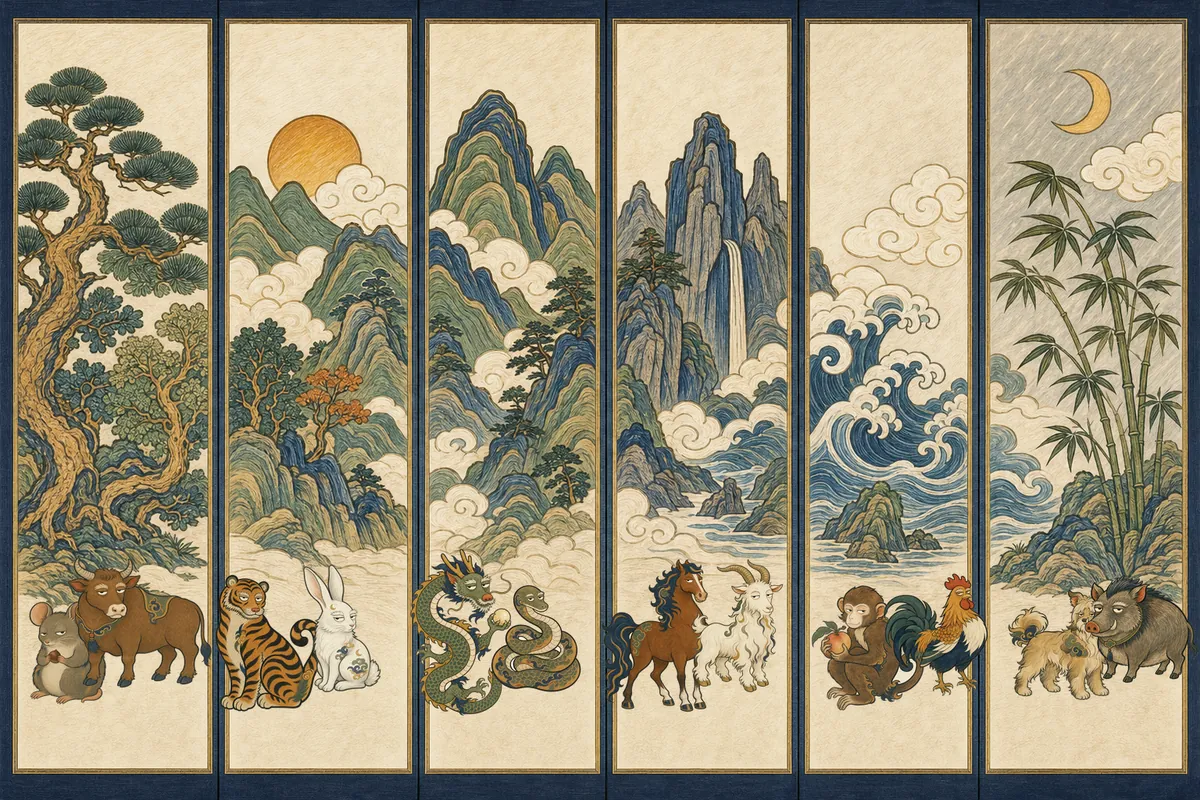
In Korea, there’s a polite way to figure out someone’s age without asking it outright: you ask their tti (띠), their zodiac animal. “I’m a Dog.” “Oh, me too!” or “Ah, so you’re one year older than me.” Since the animals repeat every 12 years, the animal plus a rough guess at someone’s age does the math for you.
That’s the animal most people know. But in Saju, the twelve animals aren’t only about your birth year. Each one is a whole bundle of meaning: an element, a season, a time of day, and a few hidden energies tucked inside. And they show up four times in your chart, not once.
Quick answer: In Saju, each of the 12 animals is first a season and an element: Tiger and Rabbit are spring Wood, Snake and Horse summer Fire, Monkey and Rooster autumn Metal, Pig and Rat winter Water, and the Ox, Dragon, Goat and Dog are Earth between seasons. You have four animals in your chart, not one.
Animals as seasons, not personalities
Popular zodiac columns give each animal a personality. Rats are clever, Oxen are hardworking, and so on. Saju takes a different angle. An animal (an Earthly Branch) is first of all a slice of the year and the element that’s strongest in it.
- Spring (Wood): Tiger, Rabbit
- Summer (Fire): Snake, Horse
- Autumn (Metal): Monkey, Rooster
- Winter (Water): Pig, Rat
- Between seasons (Earth): Ox, Dragon, Goat, Dog
The four Earth animals are like the hinges of the year. Each one sits at the end of a season, holding a little of what came before and getting ready for what comes next.
The twelve at a glance
Beginner note: you don’t need to memorize this table. To keep it simple, the “Hidden inside” column groups each animal’s hidden stems by element rather than listing every stem by name.
| Animal | Element | Hidden inside | Traditional harmony | Traditional clash |
|---|---|---|---|---|
| Rat (子) | Water | Water | Ox | Horse |
| Ox (丑) | Earth | Water, Metal, Earth | Rat | Goat |
| Tiger (寅) | Wood | Earth, Fire, Wood | Pig | Monkey |
| Rabbit (卯) | Wood | Wood | Dog | Rooster |
| Dragon (辰) | Earth | Wood, Water, Earth | Rooster | Dog |
| Snake (巳) | Fire | Earth, Metal, Fire | Monkey | Pig |
| Horse (午) | Fire | Fire, Earth | Goat | Rat |
| Goat (未) | Earth | Fire, Wood, Earth | Horse | Ox |
| Monkey (申) | Metal | Earth, Water, Metal | Snake | Tiger |
| Rooster (酉) | Metal | Metal | Dragon | Rabbit |
| Dog (戌) | Earth | Metal, Fire, Earth | Rabbit | Dragon |
| Pig (亥) | Water | Earth, Wood, Water | Tiger | Snake |
A few things jump out:
- Some animals are “pure.” Rat, Rabbit and Rooster hold only their own element. They’re very concentrated.
- The Earth animals are mixed. Each Earth animal stores a bit of another season. The Dragon holds a little Water; the Dog holds a little Fire.
- Harmony and clash pairs are traditional relationships between animals. Clash pairs sit directly across the year from each other, like summer and winter. Harmony and clash aren’t compatibility scores: they show how two animals move together, or push each other into change. (Harmonies and Clashes explains how these work between two charts.)
The same animals, four times
Your chart has four pillars, and each has an animal on the bottom:
- Year animal: the famous one. Roots, family background, the wider world.
- Month animal: your birth season. This one has a big say in which elements are strong in your chart.
- Day animal: the ground under your Day Master (the character that stands for you). Your inner home, and the place of your closest partner.
- Hour animal: your plans and later life.
So when someone says “I’m a Dog,” a Saju reader might reply, “By year, sure. What’s your day animal?”
A quick example
Here’s Leo, a fictional example born June 12, 1994, at 6:30 a.m. in Seattle:
- Year animal: Dog (戌). He’s a “Dog” by tti.
- Month animal: Horse (午). Born in the Horse month, midsummer, Fire season.
- Day animal: Snake (巳). Another Fire animal, right under his Yin Earth Day Master.
- Hour animal: Rabbit (卯). Wood, from the early morning hours.
Leo has four animals, and two of them are summer Fire animals. That’s a big reason his chart runs warm. You’d never know that from “I’m a Dog.”
There’s a relationship inside his chart too. His Dog and Rabbit are a natural harmony pair, and his Dog and Horse are part of a Fire group, pulling even more warmth together. (Harmonies and Clashes unpacks these.)
Goat or sheep? Pig or boar?
You may see different names for the same animals. The Korean word yang (양) can mean sheep or goat, so you’ll find “Year of the Sheep” and “Year of the Goat” for the same year. Korea uses the Pig (돼지), where Japan’s zodiac uses the wild boar. And “Ox” and “Cow” both come from the Korean so (소). The Saju meaning is the same either way, since it comes from the branch character, not the English name. (On our Saju Type cards we draw this branch as a boar, so you’ll see names like “The Empath Boar.” It’s the same 亥, the Pig of the Korean zodiac.)
When does your animal change?
In Saju, the year animal changes at the Start of Spring (입춘), around February 4. Not January 1, and not Lunar New Year. If you were born in January or early February, check carefully. (Born Before February 4?)
Questions beginners ask
Is it bad if my animal clashes with this year’s animal?
Not by itself. A clash points to movement and change, and what it means depends on where that animal sits in your chart and what your chart welcomes.
What is samjae (삼재)?
A popular Korean folk belief about a three-year stretch tied to your year animal. Many Koreans treat it lightly today. It isn’t part of the rules our readings use, and we don’t use it to predict misfortune.
Is my animal’s personality my personality?
Partly, at most. In Saju your Day Master and your season say more about personality than any single animal.
The short version
- Each animal is a season and an element first, and a personality second.
- Earth animals carry a mix of hidden energies; Rat, Rabbit and Rooster are pure.
- You have four animals in your chart, not one.
- The day animal is often the most personal.
Want to see all four of your animals? Find them free. And if you’d like to know what your four animals say together, including any harmonies or clashes between them, the Korean Saju Birth Chart Reading covers all of that in plain English.
Keep reading: What Is a Day Pillar? · Korean Saju Has 60 Types
What's your real animal?
Free, about 30 seconds, and your birthday never leaves your phone.
Find my real animal